Tuition-Free Education
Public universities in Germany charge zero tuition fees for undergraduate and most master's programs. Students pay only a semester contribution (€150–€350), which often includes a public transport ticket.
Your pathway to world-class education and global opportunities from Zimbabwe
Germany has become the first choice for many students looking beyond English-speaking countries. The education system is strong, degrees are respected worldwide, and the cost is far more manageable compared to other popular destinations. On top of that, many universities now offer programmes in English, which makes the transition easier for international students.
At Shakil Education Group, the focus isn’t on giving broad or generic advice. Each step is handled with care, based on the latest requirements set by universities and visa authorities. From choosing the right course to preparing documents properly, the goal is simple: make sure everything is done the right way, so students can move forward without unnecessary risk or confusion
Public universities in Germany charge zero tuition fees for undergraduate and most master's programs. Students pay only a semester contribution (€150–€350), which often includes a public transport ticket.
International students are legally permitted to work 140 full days or 280 half days per year. This allowance lets you cover living costs and gain local professional experience while studying.
Upon graduation, non-EU students can extend their residence permit for up to 18 months to find a job relevant to their qualification. Germany currently faces a shortage of over 400,000 skilled workers.
A German student visa grants you freedom of movement across the entire Schengen Area. Travel to France, Switzerland, Italy, or 26 other countries during your semester breaks without extra paperwork.
Admission to German universities is highly regulated. Meeting the University Entrance Qualification (Hochschulzugangsberechtigung) is mandatory
Learn more about the education system in Germany.


Study In Germany is home to globally ranked research-driven universities.
FOM is one of Germany’s largest private universities of applied sciences, with over 50,000 students and campuses across major German cities like Berlin, Munich, Frankfurt, Hamburg and Düsseldorf. It focuses on business, management, economics, IT and engineering, and is especially known for flexible part-time and work-study programmes designed for working professionals.
Munich Business School is a state-recognised private business university in Munich, Germany, offering bachelor’s, master’s, MBA and DBA programs focused on international business and management. It’s known for small classes, strong industry links, mandatory study-abroad components and a very practice-oriented teaching style.
ISM is a well-known private business school in Germany with campuses in Dortmund, Frankfurt, Munich, Hamburg, Cologne, Stuttgart and Berlin. It focuses on international business, management, finance, marketing and digital programs, taught in English and designed with strong industry partnerships. ISM is highly international, practice-oriented and known for small class sizes and extensive study-abroad options.
Located in Munich, Germany, TUM is a leading public research university focused on engineering, natural sciences, and technology-driven innovation. It was founded in 1868 and is part of the elite TU9 group of leading German technical universities.
The University of Potsdam is a public research university located in Potsdam, Brandenburg (Germany), founded in 1991. It offers around 170 degree programmes across humanities, sciences, social sciences, law and economics, and has strong international partnerships and research links.
A quick overview of Study In Germany’s most popular study programs.
There is more to financing your education in Germany than just not having to pay tuition. The principal authority is still the German Academic Exchange Service (DAAD), which provides merit-based stipends that include both monthly living stipends and travel allowances. Furthermore, high-achieving students receive €300 per month through the Deutschlandstipendium, which is partially funded by private sponsors and partially by the federal government. Political foundations, including the Friedrich-Ebert-Stiftung and the Konrad-Adenauer-Stiftung, offer targeted grants to researchers engaged in social initiatives. Unlike funding models in some other countries, German funding mechanisms emphasize academic merit rather than financial circumstances; therefore, prompt application and precise documentation are crucial for securing support. This discussion will briefly outline the most popular study programs in Germany for international students, focusing on disciplines that demonstrate strong career prospects and global appeal.

Our Scholarship team will help you with any questions Ask now
Follow our 6 step-by-step guide to make your study abroad journey simple and stress-free. From application to arrival, we cover every stage with expert support.
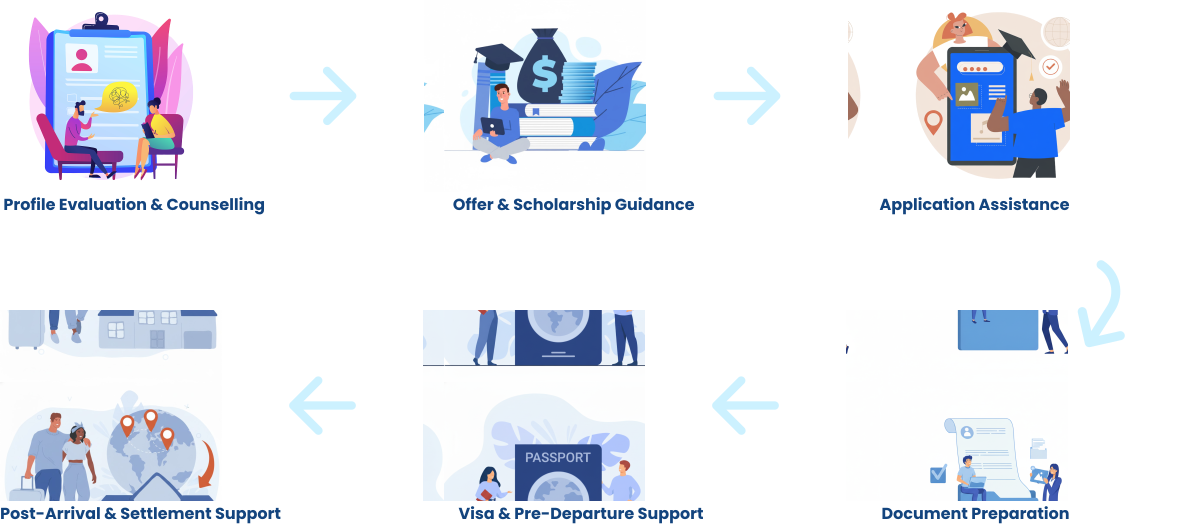
Have questions about studying abroad? Our FAQ section gives you clear and simple answers to guide your journey.