Introduction: Everything You Need to Know to Secure Your Canadian Study Permit
Getting accepted into a Canadian university is a significant milestone, but the journey truly begins with the visa application process. As a member of EAIE, ICEF, British Council, PIER, and FADCAB, I’ve seen many students struggling with their plan to study abroad. Here I’m sharing some insights from my own experience and knowledge to make your process easier. As of January 2026, Canada has updated its immigration policies, including faster processing for certain students and higher financial thresholds.
This guide provides a clear, step-by-step roadmap to help you navigate the process with confidence.
Take the First Step - Get Your Free Study Consultation!
Book Free Consultation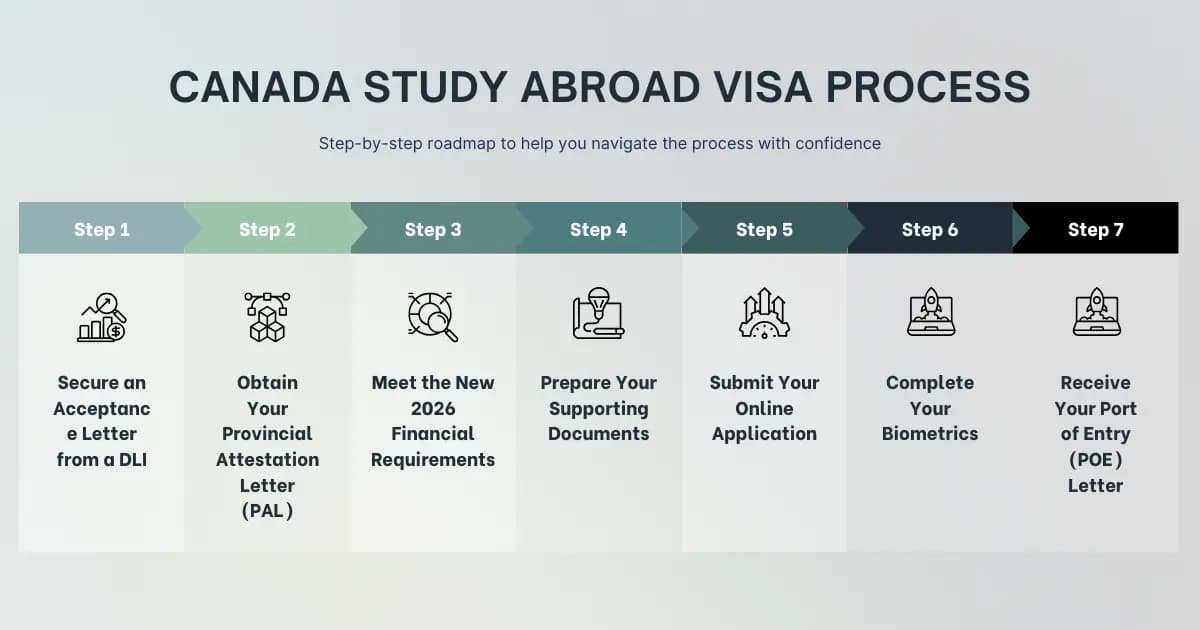
Step 1: Secure an Acceptance Letter from a DLI
Before you apply for a visa, you must be accepted by a Designated Learning Institution (DLI). This is a school approved by a provincial or territorial government to host international students.
- The Document: You need the official Letter of Acceptance (LOA).
The Verification: IRCC now verifies LOAs directly with the schools. Ensure your school confirms your acceptance promptly to avoid delays.
Step 2: Obtain Your Provincial Attestation Letter (PAL)
The PAL is a mandatory document for most students, but there are major changes in 2026:
- Undergraduate Students: You must include a PAL with your application. Most schools issue this after you pay your tuition deposit.
Graduate Students (Master's & PhD): As of January 1, 2026, students in graduate programs at public institutions are exempt from the PAL requirement.
Step 3: Meet the New 2026 Financial Requirements
One of the most common reasons for visa refusal is "insufficient funds." For 2026, the financial bar has been raised to reflect the current cost of living.
- The Amount: Single applicants must show at least $22,895 CAD for living expenses, plus the cost of their first-year tuition and travel.
- Accepted Proof: A Guaranteed Investment Certificate (GIC), bank statements from the last 4 months, or proof of a student loan.
Step 4: Prepare Your Supporting Documents
Gathering your paperwork early is the best way to ensure a smooth application. You will typically need:
- Proof of Identity: A valid passport and two recent passport-sized photos.
- Statement of Purpose (SOP): A letter explaining why you want to study in Canada and proving you will return home after graduation.
- Medical Exam: A report from an IRCC-approved panel physician.
Step 5: Submit Your Online Application
Most students must apply online via the IRCC Secure Account.
- Fees: The study permit fee is $150 CAD, and the biometrics fee is $85 CAD.
- Fast-Track: If you are a PhD student, your application is now eligible for 2-week priority processing if submitted correctly.
Step 6: Complete Your Biometrics
After submitting, you will receive a Biometrics Instruction Letter (BIL).
- The Appointment: You must visit a Visa Application Centre (VAC) to have your fingerprints and photo taken.
- Deadline: You usually have 30 days from receiving your letter to complete this step.
Step 7: Receive Your Port of Entry (POE) Letter
If approved, you won't receive the actual permit yet. Instead, you'll get a POE Letter of Introduction.
- At the Border: When you arrive in Canada, show this letter to a Border Services Officer. They will then print and hand you your official Study Permit.
Frequently Asked Questions
01. How long does the process take?
The visa process varies depending on the country. On average, it takes 3-4 weeks, but it’s best to apply well in advance.
02. Can I work while studying?
Yes, most study permit holders are eligible to work up to 24 hours per week off-campus during academic sessions.
03. What are the common reasons for student visa rejection?
Common reasons for student visa rejection include incomplete documentation, insufficient proof of financial resources, and failure to meet academic qualifications.
04. Can I extend my study visa in Canada?
International students may want to know if they can extend their study visa if their course duration is longer than initially planned. The answer is yes, as long as they apply for an extension before the current visa expires.
05. Do I need a medical exam for a Canada study visa?
Some students may need to undergo a medical exam, especially if they have lived in certain countries or plan to study in programs related to health care. This requirement is typically based on where the student is coming from and the length of stay in Canada.
06. Can I bring my family members on a Canada study visa?
Students often want to know if they can bring their spouse or children with them while studying in Canada. The answer is yes; your spouse can apply for an open work permit, and your children can attend school in Canada, but additional documentation is required for them.
07. What happens if my Canada study visa is rejected?
This is a common concern among students. If a study visa is rejected, students may need to reapply with additional documentation or clarification regarding their case. Reasons for rejection may include insufficient funds, incomplete documents, or doubts about the applicant’s intent to leave Canada after their studies.
08. Can I switch schools after getting my Canada study visa?
After obtaining a study visa, students may ask if they can switch schools in Canada. Yes, students can change institutions, but they must ensure that the new school is a Designated Learning Institution (DLI). In some cases, students may need to update their visa application or inform the immigration office.
09. What documents are required for a Canada study visa application?
Students often want a clear list of required documents. This typically includes:
- Valid passport
- Letter of acceptance from a DLI
- Proof of sufficient funds
- Passport-sized photographs
- Statement of purpose
- Medical exams (if applicable)
- Police certificates (if applicable)
10. Can I travel to Canada on a tourist visa and then apply for a study visa?
Some students wonder if they can enter Canada on a tourist visa and then switch to a study visa. Generally, it's better to apply for a study visa before traveling to Canada. Changing visa status while in Canada can be complicated and may lead to delays or denials.