System NoticeWe're enhancing our site to serve you better and for better experience. We apologize for any temporary interruptions.System NoticeWe're enhancing our site to serve you better and for better experience. We apologize for any temporary interruptions.
Living Cost in Germany | Expenses for Bangladeshi Students

Living Cost in Germany | Expenses for Bangladeshi Students

Discover real living costs in Germany for international students: accommodation, food, transport, insurance, and city-wise expenses to budget smartly.

Understanding the Cost of Living in Germany

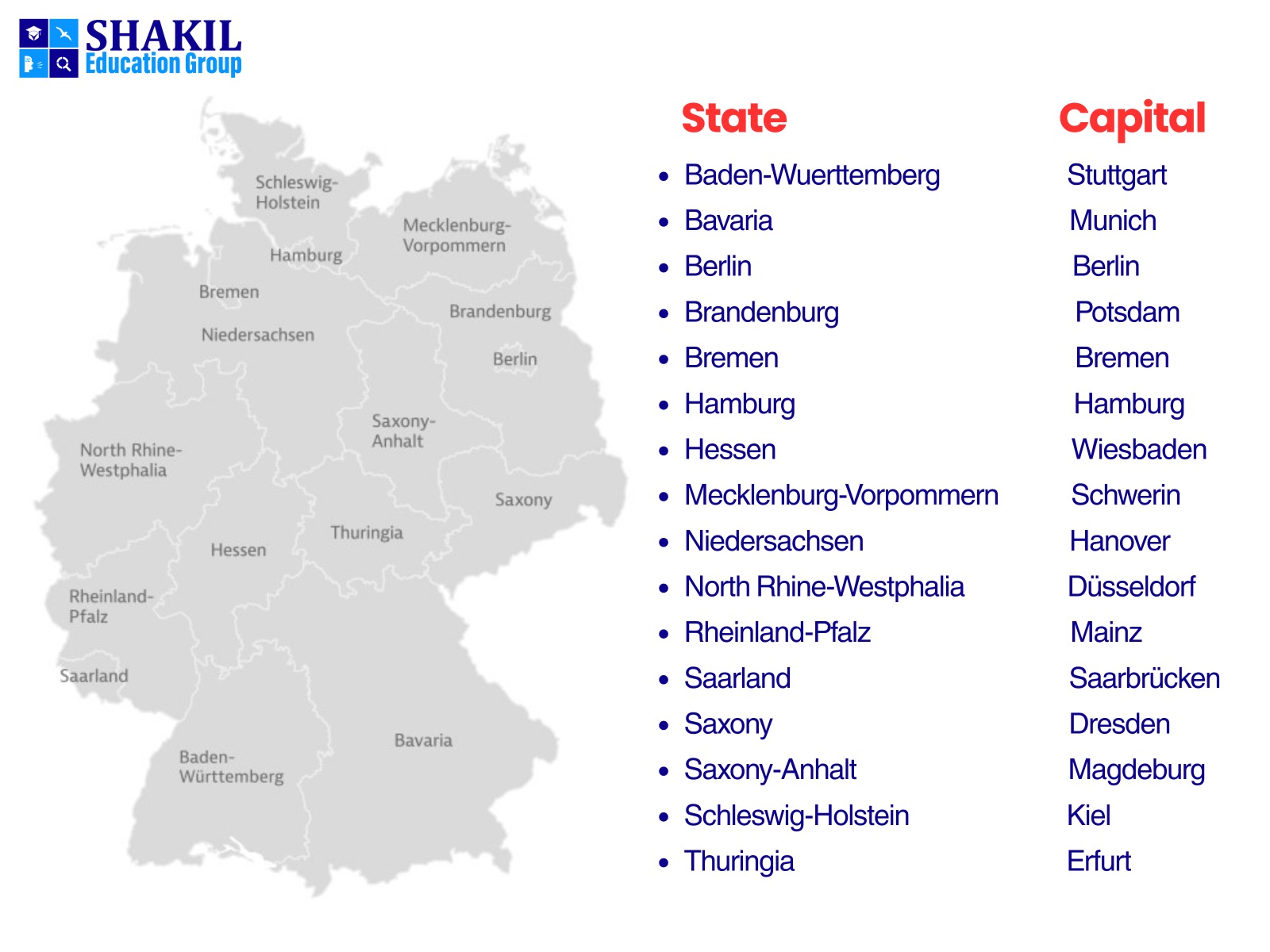
Germany States and Capital

A single person (such as a student) in Germany must, at the very least, earn €992 per month (about $1,140 US dollars) or €11,904 annually to pay living expenses.

With rent excluded, a family of four should budget an average of €3,406 (about $3,919 US dollars) every month.

As you continue reading, we will discuss the most and least expensive areas, as well as the price of lodging, food, transit, and other significant costs in various German cities.
Germany is large—there are 16 federal states (Länder) and around 11,000 municipalities.
So, prices may vary a lot from one place to another, which is why it’s important to dive a little deeper to understand the cost of living.

Top Student-Friendly Cities in Germany

1. Berlin

  • Why it’s great for students: Berlin is known for its rich culture, affordable living, and extensive public transportation system. It’s home to a diverse and vibrant student community.
  • Average Rent: €700-€1,200 per month (city center).
  • Highlights: A hub for art, music, and history, with a plethora of museums, galleries, and cultural events. Plus, many universities offer English-taught programs.

2. Munich

  • Why it’s great for students: Munich offers a high quality of life, numerous job opportunities, and some of the country's top-ranked universities. Although rent is on the higher side, the city’s lifestyle and work prospects make it a great choice for many.
  • Average Rent: €1,200-€1,800 per month (city center).
  • Highlights: Home to world-class institutions, beautiful parks like the English Garden, and rich cultural events. Students can enjoy the famous Oktoberfest and vibrant nightlife.

3. Leipzig

  • Why it’s great for students: Known for its low living costs and growing student population, Leipzig is gaining recognition as a student-friendly city. It has a thriving arts and music scene.
  • Average Rent: €400-€600 per month (city center).
  • Highlights: A dynamic student scene, affordable living, and a variety of cultural events. It’s an excellent choice for students who want to live in an up-and-coming city.

5. Freiburg

  • Why it’s great for students: Known for its sustainable living practices and beautiful surroundings, Freiburg is an eco-friendly city with a relaxed vibe.
  • Average Rent: €600-€1,000 per month (city center).
  • Highlights: Close to the Black Forest, which is perfect for outdoor enthusiasts. The city is also known for its green spaces, student activism, and beautiful medieval architecture.

6. Cologne

  • Why it’s great for students: Cologne is an international city with a large student population and a diverse cultural scene. The city is affordable and has one of the most affordable transport systems.
  • Average Rent: €600-€1,000 per month (city center).
  • Highlights: Home to a stunning cathedral (Kölner Dom), and renowned museums and galleries. Cologne is a lively city for students, with many bars, cafés, and shops.

7. Düsseldorf

  • Why it’s great for students: Düsseldorf is known for its strong economy, vibrant art scene, and excellent public transport. It’s ideal for students who want to study in a city that blends modernity with tradition.
  • Average Rent: €700-€1,100 per month (city center).
  • Highlights: The Altstadt (Old Town) is famous for its nightlife and pubs. Düsseldorf is also a hub for fashion and the arts, making it attractive to students with creative interests.

8. Stuttgart

  • Why it’s great for students: Stuttgart is a center of industry and innovation, particularly in engineering and technology. It’s home to Mercedes-Benz and Porsche, making it a great city for students pursuing engineering and automotive studies.
  • Average Rent: €800-€1,200 per month (city center).
  • Highlights: With beautiful parks and vineyards, Stuttgart offers a quieter lifestyle than larger cities like Munich, and it has lots of green space for students to enjoy.

9. Heidelberg

  • Why it’s great for students: Known for its world-renowned university, Heidelberg is a small but charming city with a very international student population.
  • Average Rent: €700-€1,100 per month (city center).
  • Highlights: A beautiful, historic city with plenty of green spaces, walking trails, and a youthful atmosphere. It’s home to Germany’s oldest university and has a strong academic reputation.

10. Mainz

  • Why it’s great for students: Mainz is a small, vibrant city located on the banks of the Rhine River. Known for its printing history (home of Gutenberg), Mainz is a student-friendly city with a laid-back atmosphere.
  • Average Rent: €500-€800 per month (city center).

Highlights: A mix of modern culture and historical significance. It’s a smaller city, so it offers a more peaceful and affordable environment, with access to nearby Frankfurt.

The South of Germany Is the Most Expensive: Munich & Stuttgart

Generally speaking, the south of Germany is the most expensive region in Germany in terms of living costs. In this region, Munich and Stuttgart are two major cities where the cost of living is the most expensive.

For example, the average rental one-bedroom apartment in Stuttgart city center will cost you €1,157. A similar apartment in the northern German city of Bremen costs €841 on average.

Percentage-wise, this means that renting an apartment in Bremen is 27.3% cheaper than in Stuttgart.

Berlin Remains Cheaper Than Other European Capitals

Berlin, the capital of Germany, is getting more and more expensive to live in due to the growing number of residents. The average cost of renting a small one-bedroom apartment in the city is currently about €1,231 per month.

Berlin is still more affordable than many other major European capitals, though. Rent prices here are 14.3% lower than in Paris, 54% lower than in London, 42.7% lower than in Amsterdam, and 47.3% lower than in Zurich.

Saarbrucken, Dresden, and Leipzig are among the Most Affordable in Germany

Other eastern German cities around Berlin are mostly cheaper than their counterparts in the south. Leipzig and Dresden are, in fact, some of the most affordable cities to live in Germany.

For example, rent in Leipzig is cheaper than in Stuttgart by over 38.7%, albeit their population size is similar. Dresden, as well, is similar in size, and rent costs 37.1% less than in Stuttgart.

Saarbrucken is the cheapest among major cities. It’s smaller in population size (around 180,000 inhabitants), but compared to Heidelberg (which has an even smaller population size), rent is 51.1% lower

The Priciest Cities Within Each Zone: A Comparison

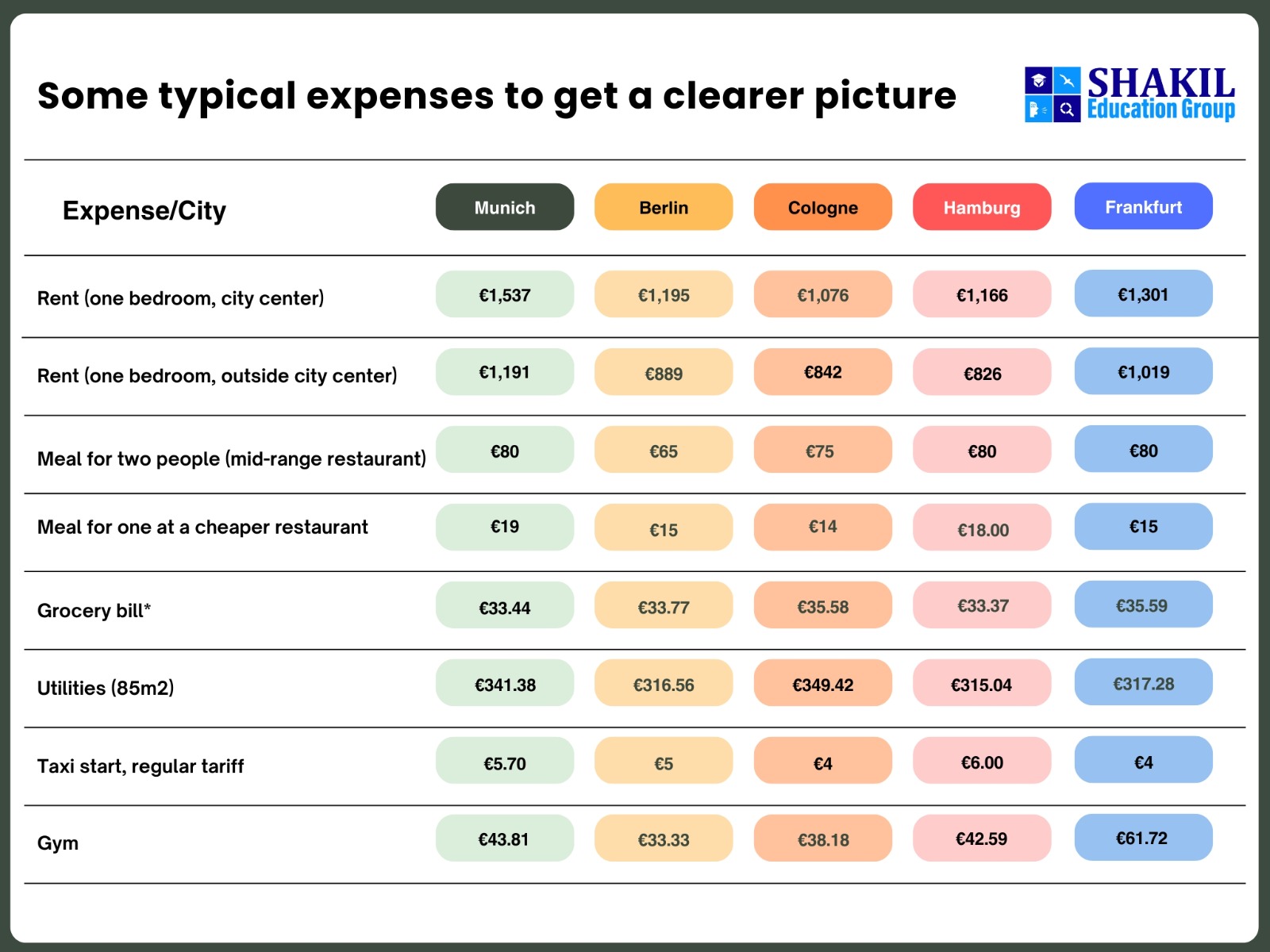
Germany Expences based on cities

Another way to compare the cost of living in different German regions is by looking at the largest cities in Germany’s main metropolitan areas.

  • Hamburg
  • Berlin
  • Cologne (Rhine-Ruhr)
  • Frankfurt (Frankfurt/Rhine-Main)
  • Munich

Based on these categories, Munich and Frankfurt share the top spot for the most expensive, followed by Berlin, Hamburg, and Cologne.

However, the biggest chunk of monthly expenses for the average German goes to rent.

In this category, these cities rank as follows (from most expensive to least):

  1. Munich
  2. Frankfurt
  3. Berlin
  4. Hamburg
  5. Cologne

We calculated the cost of a grocery bill with these items: 1L milk, 1 loaf of white bread, 1kg white rice, 12 eggs, 1kg chicken fillets, 1kg apples, 1kg bananas, 1kg tomatoes, 1kg potatoes, 1kg onions, 1 head lettuce, and a 0.5L bottle of local beer.

What Is the Average Rent in Germany?

City wise cost breakdown in Germany

Renting an apartment in Germany varies significantly depending on the city. In cheaper cities like Saarbrücken, rent starts at €500 per month, while in Munich, it can go up to €1,537. On average, rent for a one-bedroom apartment in the city center across Germany is €865 per month.

Bigger cities like Munich, Berlin, Hamburg, and Frankfurt are more expensive due to higher rent, while places like Essen or Saarbrücken are cheaper. Rent for a one-bedroom apartment in city centers ranges from €550 to €1,500, with larger, fully furnished apartments costing between €1,000 and €2,900 per month.

To save on rent, many people choose to live outside city centers, where one-bedroom apartments cost between €430 and €1,190 per month.

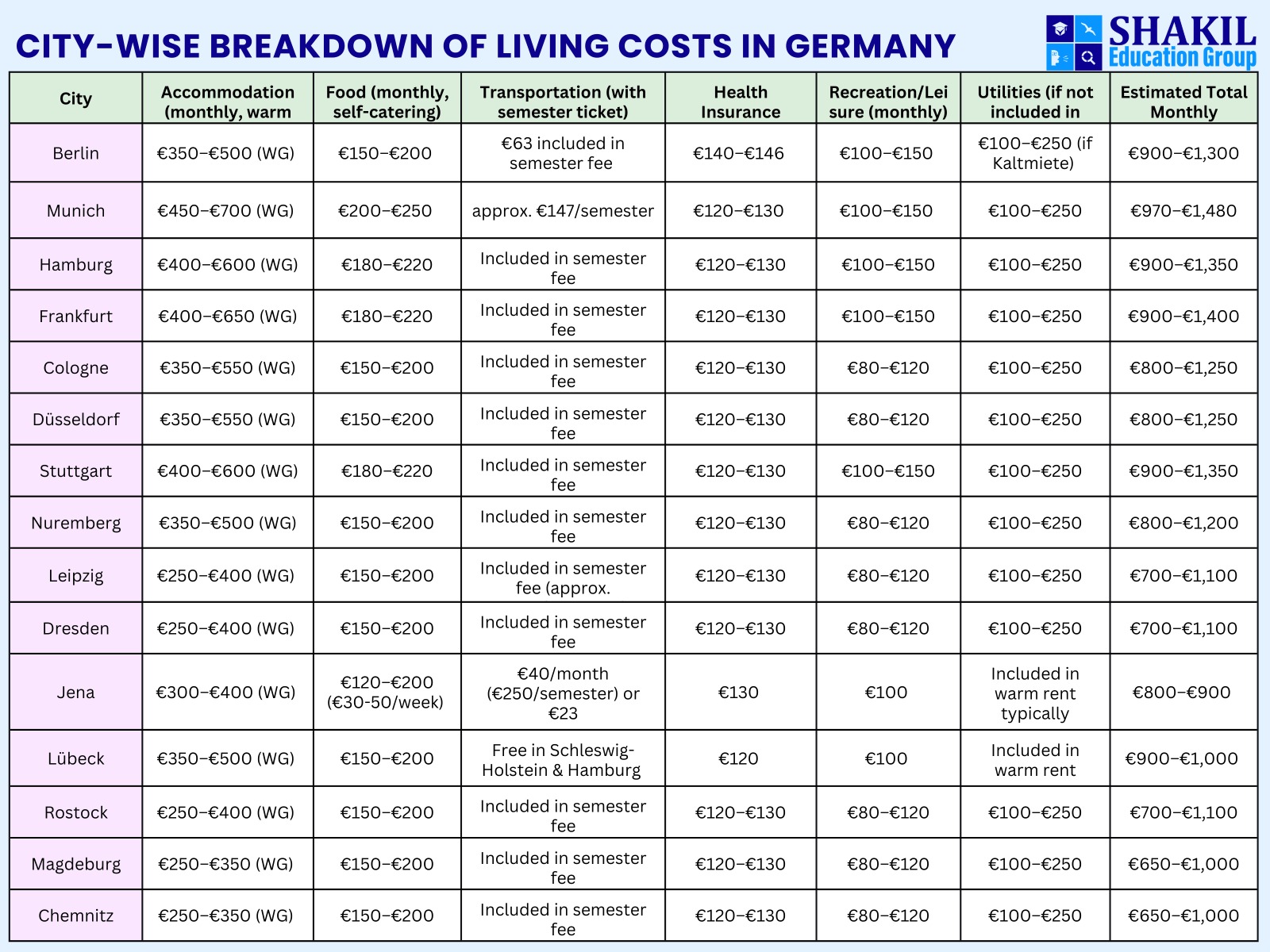
City-Wise Breakdown of Living Costs in Germany

To help you plan, here’s a detailed breakdown of the living costs in some of the most popular cities for international students in Germany.

What You Will Actually Eat (and Buy) in Germany

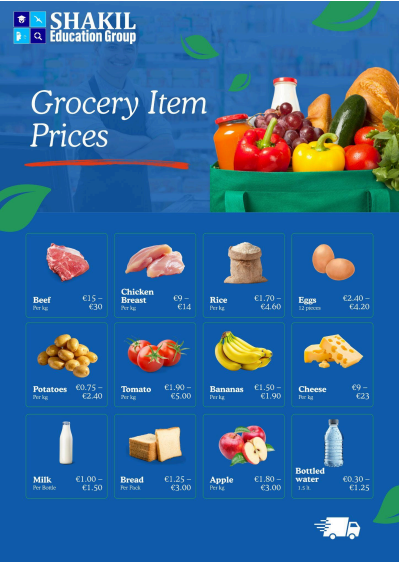
Grocery itemps prices in Germany

When you finally drop your bags in your new room, your next immediate problem is figuring out how to feed yourself. Learning how locals eat is not just about experiencing the culture; it is the easiest way to keep your grocery bills low and avoid wasting your budget on expensive tourist restaurants. Let us look at what is actually going to end up in your supermarket cart.

The Staples of a German Diet

The Bread Culture (Brot): Forget the soft, sliced white bread you might be used to. German bakeries produce over 300 different types of dense, heavy bread. Dark rye bread (Roggenbrot) is a daily staple, and grabbing a fresh, salty pretzel (Brezel) from a train station bakery is the standard quick snack between your university lectures.

Sausages (Wurst): This is the ultimate cheap street food. Whether you buy a classic grilled Bratwurst, a sliced Currywurst drowned in spiced ketchup, or a traditional Bavarian Weisswurst, it is fast, affordable, and available on almost every street corner.

The Potato Base (Kartoffeln): While rice and pasta are obviously available, the potato still rules the traditional kitchen. You will buy them in bulk because they are incredibly cheap. Expect to eat them boiled, pan-fried, mashed, or mixed into a cold potato salad for student barbecues.

Sauerkraut: This is a finely cut, fermented cabbage usually served hot alongside heavy pork or sausage dishes. It has a very distinct, sharp, sour taste. You might not love it on your first try, but it is a massive part of the historical local diet.

Cheese and Dairy (Käse): The dairy aisle in a German discount supermarket is massive. You will find large blocks of hard cheese like Emmental for your sandwiches. More importantly, you will discover Quark. This is a thick, high-protein dairy product similar to yogurt or soft cheese. Students buy tubs of it constantly because it is healthy and costs very little.
Sweets and Pastries: Germany takes its baking seriously. While you should sit down in a cafe to try a real slice of Black Forest cake (Schwarzwälder Kirschtorte) at least once, your daily routine will be much simpler. Most students rely on the cheap, fresh pastries sold at local bakeries to pair with their morning coffee.

Navigating the German Supermarket Hierarchy in Germany

Where you choose to buy your groceries will make or break your monthly budget. If you walk into the wrong store for your daily essentials, you will burn through your Blocked Account funds much faster than necessary. Let us break down the local supermarket landscape, so you know exactly where to go on your first day.

The Discounters: Your Everyday Budget Savers

If you want to keep your living costs strictly within budget, Aldi and Lidl are your main targets. They do not bother with fancy store displays; instead, they pass those operational savings directly to you.

  • Aldi: This is your absolute baseline for cheap, high-quality private-label goods. To give you an idea of the math,

Typical Prices:

Milk (1 liter): €0.79
Eggs (10-pack): €1.99
Bread (500g): €1.00
Apples (1 kg): €2.49

  • Lidl: Aldi's biggest rival operates on the same logic but often features a slightly larger fresh bakery and meat section. The Standard Markets: Better Selection, Higher Prices.

Typical Prices:
Milk (1 liter): €0.89
Eggs (10-pack): €2.49
Bread (500g): €1.20
Chicken Breast (1 kg): €6.99

You will eventually need a specific ingredient that the discounters simply do not carry, especially if you are cooking international dishes from back home. That is when you step up to the mid-tier and premium stores.

  • Rewe: This is a highly reliable middle ground. They stock a massive variety of name brands and international products. Naturally, the prices creep up a bit to match the variety. 

Typical Prices:
Milk (1 liter): €0.99
Eggs (10-pack): €2.39
Bread (500g): €1.20
Tomatoes (1 kg): €2.49

  • Edeka: Consider this the highest tier for your daily shopping. The stores are well-designed, the organic produce selection is massive, but you definitely pay a premium for the experience. Locals always advise students to only shop here for specific specialty items, not their bulk weekly staples.

Typical Prices:
Milk (1 liter): €1.09
Eggs (10-pack): €2.99
Bread (500g): €1.50
Cheese (200g block): €2.00

The Hypermarket Option

  • Kaufland: If your city has a Kaufland nearby, take full advantage of it. It operates like a massive superstore selling both groceries and general household items. Because of their sheer size, their prices compete directly with the discounters. It is the perfect place to do a massive, cheap haul once a month.

Typical Prices:
Milk (1 liter): €0.85
Eggs (10-pack): €2.19
Bread (500g): €1.30
Potatoes (1 kg): €1.49

What You Actually Pay to Eat Out in Germany

Sitting down at a restaurant here adds up fast. If you go out with a friend, even a casual place—say, an Italian spot or a beer hall—usually leaves you with a bill around €65. It is not fine dining, just normal dinner pricing.
That is why you see so many students walking around with Döner kebabs. It is the unofficial student meal. You get a sandwich loaded with meat and veggies for about €15, and it actually fills you up.
Drinks are where they get you. A half-liter of beer runs close to €4.50. If you are not drinking, a cappuccino is around €3.55. Even a small bottle of water or a soda will cost you. It adds up before the food even arrives.
If you are used to eating out often, Germany might force you to adjust. Most students here learn to cook because doing it yourself is the difference between saving money and watching it disappear.

What Groceries Actually Cost 

Here’s an overview of the typical grocery prices for some common items in Germany. Keep in mind that prices can vary depending on the city and the store:

Item

Average Price

Milk (1 liter)

€0.79 - €1.09

Eggs (10-pack)

€1.99 - €2.99

Bread (500g)

€1.00 - €1.50

Chicken Breast (1 kg)

€6.00 - €8.00

Apples (1 kg)

€2.49 - €3.50

Potatoes (1 kg)

€1.49 - €2.00

Cheese (200g block)

€1.50 - €3.00

Tomatoes (1 kg)

€2.49 - €3.00

Pasta (500g)

€0.69 - €1.00

Coffee (500g)

€2.99 - €4.99

Healthcare System

The healthcare system in Germany is one of the best in the world. It provides high-quality medical care, advanced hospitals, and mandatory health insurance for everyone, including international students and workers. Before moving to Germany, it’s important to understand how the system works.

Structure of the German Healthcare System

Germany has a universal healthcare system, meaning everyone must have health insurance.

There are two main types of health insurance:

Insurance Type

German Name

Who Uses It

Public health insurance

Gesetzliche Krankenversicherung (GKV)

Most students and employees

Private health insurance

Private Krankenversicherung (PKV)

High-income earners and some freelancers

About 90% of people use public health insurance.

Major public insurers include:

  • Techniker Krankenkasse
  • AOK
  • Barmer
  • DAK-Gesundheit

Health Insurance for International Students

Health insurance is mandatory for student visas and university enrollment.

Student Health Insurance Cost

Age

Monthly Cost

Under 30 years

€120 – €140

Over 30 years

€160 – €220

This insurance covers most medical services.

What Public Health Insurance Covers

Public insurance usually covers:

  • Doctor visits
  • Hospital treatment
  • Prescription medicines
  • Mental health services
  • Pregnancy care
  • Emergency treatment

Example Coverage

Medical Service

Coverage

General doctor visit

Fully covered

Hospital stay

Mostly covered

Prescription medicine

Small co-payment

Dental basic treatment

Partially covered

Emergency services

Fully covered

Doctors and Medical Care

Healthcare services are delivered through different types of doctors.

Types of Medical Providers
 

Provider

Role

General practitioner (GP)

First contact doctor

Specialists

Dermatologist, cardiologist, etc.

Hospitals

Major treatments and surgeries

Pharmacies

Medication and advice

Students often visit a general practitioner first before seeing specialists.

Hospitals in Germany

Germany has over 1,900 hospitals with modern medical technology.

Hospitals can be:

Type

Description

Public hospitals

Government-run

Non-profit hospitals

Often run by charities

Private hospitals

Privately owned

Emergency departments provide 24/7 medical care.

Emergency Healthcare

Important emergency numbers:

Emergency Service

Number

Ambulance / medical emergency

112

Police

110

Emergency services are available nationwide and very reliable.

Pharmacies (Apotheke)

Pharmacies are called Apotheke in Germany.

Key features:

  • Highly trained pharmacists
  • Prescription medication is available only with a doctor’s prescription
  • Many pharmacies offer consultation and health advice

Healthcare Quality

Germany consistently ranks among the top healthcare systems globally due to:

  • Highly trained medical professionals
  • Advanced hospitals and research
  • Universal health insurance coverage
  • Short waiting times compared to many countries

Mental Health Services

Germany offers good mental health support.

Covered services include:

  • psychotherapy
  • psychiatric treatment
  • counseling services at universities

However, waiting times for therapy can sometimes be longer.

Digital Health Services

Healthcare is becoming increasingly digital.

Examples include:

  • electronic prescriptions
  • online doctor appointments
  • health insurance mobile apps

Some insurers like Techniker Krankenkasse offer digital health services.

Healthcare Costs Without Insurance

Healthcare in Germany can be very expensive without insurance.

Medical Service

Approximate Cost

Doctor visit

€50 – €150

Hospital stay (per day)

€300 – €1,000

Surgery

€2,000 – €20,000

This is why health insurance is legally required.

Advantages of the German Healthcare System

Major benefits include:

  • Universal access to healthcare
  • High-quality hospitals and doctors
  • Comprehensive insurance coverage
  • Strong medical research and innovation

Important Things to Know Before Moving

Before arriving in Germany, students should:

  • Arrange health insurance before visa application
  • Carry insurance documents
  • Register with a local doctor
  • Know emergency numbers (112)

Simple Summary

The healthcare system in Germany is based on mandatory health insurance, mainly through public insurance providers. It provides high-quality medical care, modern hospitals, and comprehensive coverage for residents, including international students.

Students typically pay around €120–€140 per month for health insurance, which covers most healthcare services.

Free Study Abroad Consultation

Get personalized guidance on admissions, scholarships, and visas — free of cost.